Iranian Foreign Minister Abbas Araqchi and his Russian counterpart Sergei Lavrov held talks in Moscow on Wednesday, and later addressed a joint press conference to outline the results of their discussions.
Lavrov said the two sides reviewed the state of bilateral relations, noting that the comprehensive strategic partnership treaty between the two countries had been signed in 2025 and that the presidents of Iran and Russia had discussed its implementation during a meeting in Turkmenistan the previous week.
He added that political issues, as well as trade and investment matters, were discussed, pointing out that bilateral trade had grown by 10 percent this year.
The Russian foreign minister emphasized the need to expand contacts between the private sectors of the two countries and described Iran’s relations with the Eurasian Economic Union as highly important.
He said Moscow remains interested in developing bilateral ties and noted that discussions were also held on the Rasht-Astara railroad project, which would contribute to the development of the North-South transport corridor.
Lavrov described consultations between Iran and Russia on regional issues as close, saying the two countries are seeking greater democratization of international relations. He stressed their emphasis on multilateralism, adding that the West has unfortunately ignored this principle, and underlined the need to respect international law and its principles.
Moscow and Tehran have agreed to work with like-minded members of the international community and have also discussed ways to neutralize the effects of sanctions, Lavrov stated.
Referring to Iran’s nuclear program, Lavrov stated that Iran, as a member of the International Atomic Energy Agency, has the right to enrich uranium.
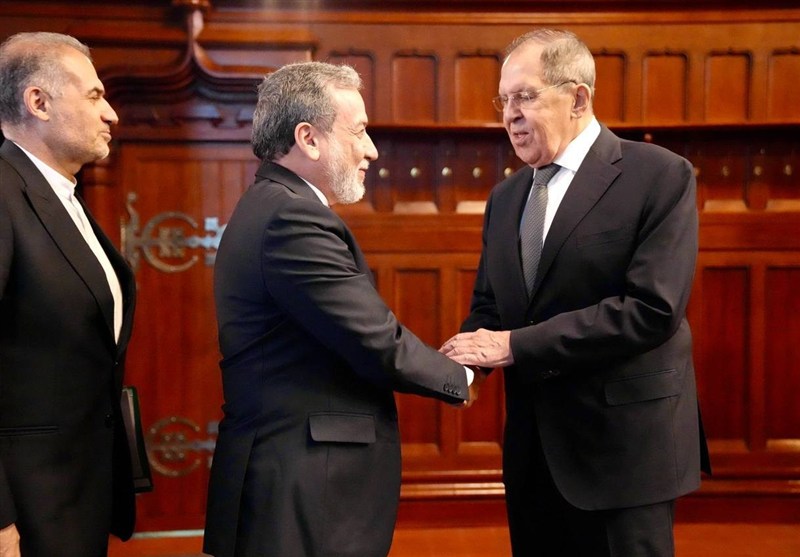
Araqchi, for his part, said detailed negotiations have been held on all issues and noted that Iran-Russia relations have witnessed extraordinary expansion, gaining further momentum following the signing of the comprehensive treaty.
He added that an agreement signed on Wednesday defines the agenda of the two foreign ministries, describing bilateral relations as comprehensive. Araqchi said Iran and Russia share common positions in the political sphere and maintain regular consultations.
The Iranian foreign minister noted that economic relations have expanded significantly, particularly in the energy and transport sectors, and said bilateral trade is on the rise, with new areas identified for further growth.
Araqchi stressed that defense and security cooperation between the two countries is continuing. He said his talks with the Russian side have covered regional issues including the Caucasus, Afghanistan, Ukraine, and Palestine, as well as crimes committed by the Israeli regime.
On Iran’s nuclear issue, Araqchi said he has explained that Iran is a committed member of the NPT, remains bound by its obligations, but will not forgo its rights, including the peaceful use of nuclear energy and uranium enrichment.
He added that Tehran and Moscow share views on international issues and have consulted on countering the dominance system imposed by the US.
Araqchi stated that the concept of “peace through strength,” promoted by Washington, was dangerous for the international community, warning that reliance on force instead of law could push the world toward a “law of the jungle.”
Referring to sanctions, Araqchi said Iran and Russia have been targeted by unjust Western sanctions. He expressed appreciation for Russia’s position in deeming the actions of the European troika at the UN Security Council illegal, saying European states and the US have no right to restore past sanctions and that such moves are null and void from Iran’s perspective.
Iran and Russia are cooperating and exchanging views on countering unilateral US sanctions, Araqchi stated.