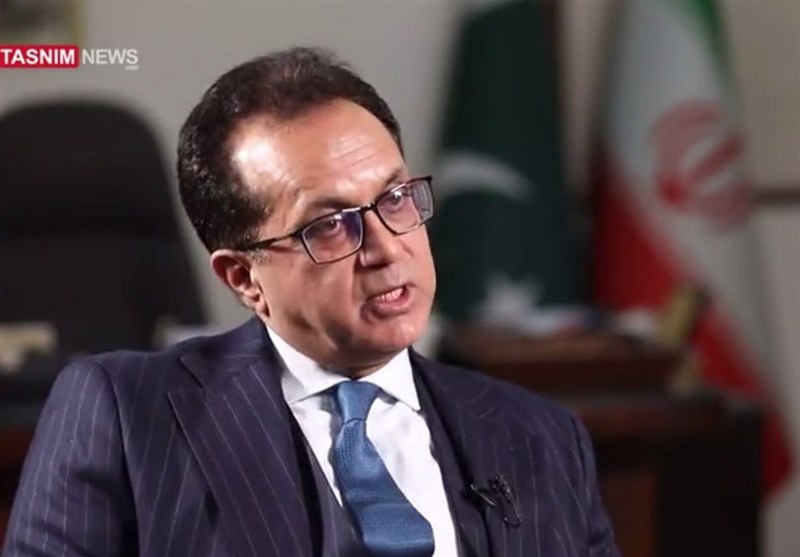
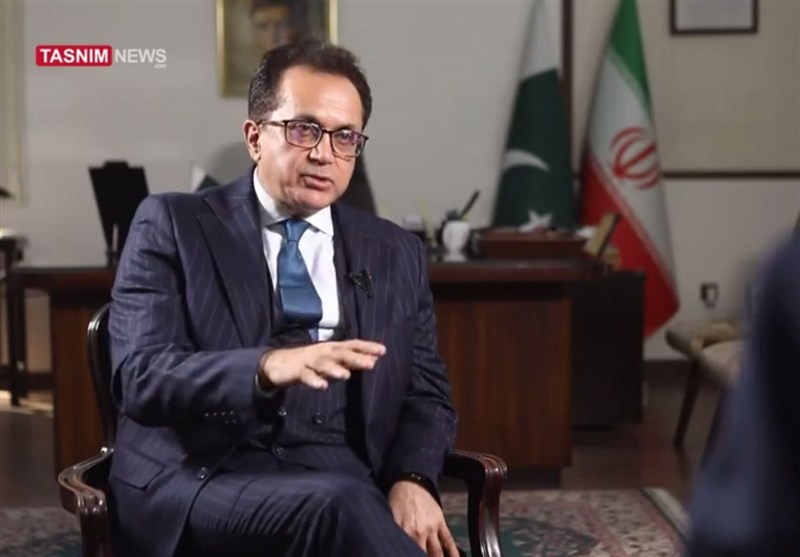
In an exclusive interview conducted at the Embassy of the Islamic Republic of Pakistan in Tehran, Tasnim News Agency correspondent engages with Pakistan's Ambassador to Iran, Mudassir Tipu, on a wide range of bilateral and regional issues.
The ambassador highlighted plans to elevate bilateral trade from $3.1 billion to $10 billion, emphasized turning perceived competition between Gwadar and Chabahar ports into complementarity, expressed optimism about an imminent free trade agreement and expanded barter trade, and underscored robust security cooperation along the shared 900-kilometer border.
The ambassador also addressed regional challenges, including terrorism concerns in Afghanistan, Iran's positive role in regional mediation, Pakistan's independent foreign policy amid relations with both Iran and the United States, and shared support for peace in Gaza and the broader Middle East, while praising Iran's resilience following recent 12-day war with the Israeli regime.
The full text of the interview is as follows:
.
Tasnim: The trade volume between Iran and Pakistan seems to be far from potential. What plans does Pakistan have in order to increase the level of economic cooperation between the two sides, specifically talking of corridors—both countries in terms of north-south, east-west corridors can have things to share in common and to cooperate. Does Pakistan have any plan to connect Gwadar port to Iranian ports? Can the competition between Gwadar and Chabahar be turned into a kind of complementarity? What potentials are there to increase this cooperation as well?
Ambassador: But first off, right at the beginning, let me extend my best wishes to the entire Iranian nation on the Yalda night. It's a civilizational moment for Iran. It's rooted in history. It's about renewal of faith, love, compassion. Yesterday the honorable president of Pakistan, while passing through Iranian airspace, sent his message to the Iranian people, demonstrating the kind of relationship that we have. He also expressed his best sentiments on the Yalda night. On behalf of the entire Pakistani leadership, let me also resonate that message.
I think that in the past few years the amount and volume of trade has gone up. Now we have trade of about $3.1 billion. We are going to take it up to $10 billion. As the honorable prime minister [of Pakistan] and honorable president Pezeshkian agreed, we are taking very concrete measures to achieve that. It will take a bit of time because trade is part of logistical chains, supply chains, regulatory framework, institutional framework, but I think there is a huge political commitment.
Of course, corridors are very important. Iran's role in regional connectivity is very important. We are going to open the Iran-Islamabad-Tehran-Turkey railway network once that is resumed. I think this is going to be a huge development in terms of regional connectivity. We are already in discussion with Iran on creating more cooperation between Chabahar and Gwadar. We are already in consultation. I don't think it's about competition. I think it's about cooperation because both countries have very diverse advantages, they have their own skill sets. Now the time has come that our people come together, our industry, our government and our regulatory frameworks come together to make sure that we promote maritime connectivity, railroad connectivity, road connectivity with Iran.
Tasnim: In the case of economic cooperation, we have seen external pressure or third parties try to impact the relations between Islamabad and Tehran. The IP pipeline is an example—despite the energy needs by Pakistan, we were seeing some obstacles particularly imposed by the American side. But we have also been hearing about barter and free trade agreements being discussed between the two sides. What are the obstacles, and do you think that both sides can work in order to somehow reduce the third party's impact on the bilateral relations, specifically the economic section?
Ambassador: Pakistan is completely independent, completely sovereign in deciding its foreign policy, its security policy, its economic interests, its commercial interests. The data speaks differently than what you are saying. If you look at the data, even in the past five years, trade has really gone up. In the past two years, the level of political and diplomatic engagement has been extensive, immense, far-reaching.
You are talking about impediments. The whole world, the whole trading system faces its own challenges. We live in a complicated interconnected world, and every country faces these challenges. But I think the most important thing is the kind of engagement Pakistan and Iran has. This is really exceptional. We have had many forums on which we regularly communicate with each other. We had the Pakistan-Iran business forum about 3 months ago where hundreds of companies participated—the first of its kind. Before you came here today, I was meeting a very important Iranian businessman, and the interest I have seen in the past few months has really grown very high.
You have talked about FTA(Free Trade Agreement). Yes, a large part of the agreement has been established. We are just waiting for the right time when we can address it.
Tasnim: When can be that right time—far or near?
Ambassador: It's very near. Of course I can't specify, but if it's my personal opinion, it could be close to 3 months. So free trade agreement will be signed, and I think that's a huge step forward. Then we have issued a regulatory order through which Pakistanis can do barter trade with Iran, and I think that's going to be huge. I have been receiving so many queries from Pakistan and from Iran—the businessmen asking how we are now going to take advantage of this barter trade mechanism. We are in consultation with Iran on how to practically implement the barter trade system.
On other levels we are also engaged. I have told you about connectivity. Our minister of communication was here about two to three months ago and he had a very good meeting with the honorable minister of road transport. So we have developed huge and very extensive engagement, and now we have to follow that road map. From now till the next 10 years, I see huge development.
You have to recognize we have a 900 kilometer border. This is an excellent opportunity. We have an environment—despite the challenges, and the challenges would always be there. I always look at opportunities, and I think the business communities of both countries now have very extensive engagement. The chambers are talking to each other. The business forum is happening. The trade bodies are meeting with each other. Our trade counselor regularly goes and meets with the trade authorities in Iran, trying to see how we can narrow the gaps.
Tasnim: You mentioned the extensive shared border between the two countries, which can be an opportunity for cooperation but sometimes that can be a challenge like border security and the terrorist activities conducted by terrorist groups in that shared border areas. In addition to diplomatic condemnations, what operational plans are there in order to combat that challenge which is to the detriment of the interests of both nations?
Ambassador: I think the most important thing is that both governments recognize the nature of the challenge. You also know that there is an external environment of this region which is there for past several decades. It is also going to shape the regional realities, the regional complexities. So we have to recognize the broader strategic challenges also.
But let me assure you that security cooperation between the two countries has been extremely good. A great level of trust has been developed. Our institutions, I can tell you, are regularly interacting with each other, and you have seen demonstrable results of those efforts. So on security, I am also hopeful that we will create better coordination and effective ways of handling this challenge.
Tasnim: Let's shift to an important regional issue which is Afghanistan. Contrary to predictions or expectations, we have been seeing recent challenges between Pakistan and Afghanistan—there were conflicts between the two sides. Some thought that maybe by Taliban assuming power in Kabul this could be different. Has the strategy from Pakistan toward Afghanistan or Kabul changed, or what is the root cause of the recent developments taking place between the two countries?
Ambassador: First of all, let me tell you the broad principle: We want to promote peace, development and security in the region. Certainly this is a region full of history, full of economic opportunities. So that's very important—how we can bring the people together. That is the broad principle.
Our basic concern has been terrorism and effective and decisive action against terrorism. In the past year we have had huge casualties inflicted on us. So this is a very legitimate concern of Pakistan. Our deputy prime minister went to Kabul three times, our interior minister went to Kabul. We have had many engagements at many levels trying to address this issue. So the channels of communication are open, and we hope that Pakistan's legitimate concerns will be taken very seriously by Afghanistan, and then both countries can work for peace and development.
Tasnim: Iran and Pakistan both have been hosting a great number of Afghan refugees in both countries, and their security is somehow tied to the stability in Afghanistan. How do you see Iran's role in trying to contribute to the peace between Pakistan and Afghanistan, and what is your assessment of regional initiatives in order to bring peace in the region, including this as well as more importantly the neighbors format?
Ambassador: Yeah, we really appreciate efforts of Iran. Iran is a very important member of West Asia. Iran has a long border with Afghanistan. Pakistan has a long border with Iran. So for all these three countries this is very important that all efforts are made to promote peace and security and to address the challenge of terrorism.
Iran has offered mediation—we welcome that. Last week there was a meeting of special representatives of the neighboring countries of Afghanistan plus Russia. It was a very constructive engagement in which all the countries came up with different ideas on how at regional level we can address this huge issue, and Iran played a very critical role in that. So Iran's efforts for promoting regional peace and stability are really very good. Even in the 4-day war, Iran had offered mediation—Pakistan accepted it, India rejected it—so that shows Iran's concern for regional peace and security.
Tasnim: As we speak here in Tehran, how do you see the future of Afghanistan-Pakistan relations? Are there any preconditions in order to normalize ties—political or trade relations—with Afghanistan from Pakistan's perspective?
Ambassador: I think it's very important to address Pakistan's concerns—that is really critical.
Tasnim: What are the concerns?
Ambassador: Of course this is principally terrorism emanating from Afghanistan—that's crucial, that's very important.
Tasnim: And how do you see the future—do you think that you will be able to resolve it?
Ambassador: We are in discussion, and let's see how the situation on the ground changes.
Tasnim: Another important issue in the region has been what has been taking place between Pakistan and India in the case of Kashmir. Are there any open, public, hidden or secret channels between the two countries in order to manage the relations? There have been differences or challenges on issues as I mentioned the case of Kashmir, but all in all in different aspects, are there any channels to manage and to somehow handle the situation?
Ambassador: Pakistan really believes that conflict is a very destabilizing factor in the region. So all efforts must be made to mitigate and eliminate conflict. That's very important. Pakistan welcomes all those efforts which promote peace, stability, development for the benefit of the entire region. That is what I can tell you.
Tasnim: Iran is sharing good relations with Pakistan as well as with India. Do you think that Iran can be playing any active mediating role between the two sides in this issue?
Ambassador: During the war which was imposed by India on us, Iran offered mediation. We welcomed it. As I have explained to you, Iran is making very sincere and very resolute efforts to promote peace and stability in the region, and we welcome that.
Tasnim: One thing which may be notable in the relatively past year is Pakistan sharing good relations with Iran. We've seen cases to prove the quality of these relations in the past month or years. Also Islamabad is having good ties with the United States, specifically under President Trump who is in office. How do you balance the relations between the two sides given that Iran and the United States have had challenges, tensions or even conflict? How do you try to balance these relations so the bilateral relations with Iran are not impacted by that external third element?
Ambassador: First I told you about the broad principle that Pakistan is autonomous, sovereign, independent in the foreign policy choices that it makes, in the strategic choices that it makes. This is also a reflection of the far-sightedness of Pakistan's leadership which believes that the region should be made more peaceful, more coherent and more prosperous. So in that sense we are engaging with different global powers, and the basic principle of that effort is to ensure that Pakistan's interests are protected. We have very excellent relations with the US, excellent relations with Iran, and I think that gives us a very special and unique position to be part of those efforts which promote peace and development in the region.
Tasnim: But some say, for example in the case of the IP project, an external element like the sanctions or the pressure imposed by the United States.
Ambassador: No, I have been repeatedly underlining that we are completely independent, we are completely sovereign. On the question of IP pipeline, we are already in discussions to make a way forward.
Tasnim: One important regional development which has been going on for the past couple of years is Palestine and specifically the issue of Gaza. What is your assessment now looking back at what has been happening? Also we have been hearing some Muslim countries saying that Israel needs to be held to account while some are talking about normalizing relations with Israel. What is Pakistan's view toward this phenomenon?
Ambassador: Iran has also welcomed the Middle East peace plan, the 20-point plan. Similarly Pakistan also supports any idea which can bring peace and stability. So in that sense, any idea that can promote peace and stability in the Middle East, in Gaza, and bring the war to an end—that Pakistan will support.
Tasnim: In the case of Gaza, there have been some criticisms against Israel that it is not respecting the terms of the ceasefire, and in Gaza also by attacking Lebanon—which is a separate case but yet related to the stability in the region. There have been some speculations about Pakistan also playing a role in terms of security forces being there in Gaza for the future of the region and the strip. Are there any reservations or considerations in this regard—what is the latest on that?
Ambassador: I have already told you: whenever there is violation of international law, international norms, whenever the UN charter is violated, when international humanitarian law is violated, Pakistan is on record to have clearly articulated its own position. When Iran was attacked, Pakistan was the first country which said that Iran has right to self-defense under Article 51 of the UN charter. So you can see that. I can tell you a broad principle: in the Middle East, every effort which supports peace, which supports development, which mitigates conflict—Pakistan will be part of that process.
Tasnim: Recently, a few months ago, there was a war initiated against Iran and the war of aggression was condemned by Pakistan as well. Now months have passed since then. What points can you conclude from what happened as we have been seeing recent developments in the course of time?
Ambassador: Again, I'm also going to talk about the broad principle: diplomacy, diplomatic engagement remains the best avenue to deal with the challenges. I think that wars are very punitive, very costly, and that's very important. We need a region, we need a world which is filled with peace and in which billions of people are living where they can chart out a better future for themselves. That should be the key point.
Tasnim: And to whom should this message be addressed?
Ambassador: It's broad—to everyone.
Tasnim: Because Iran was in diplomacy negotiating with the United States. All of a sudden, Israel initiated that aggression backed by the United States.
Ambassador: So I am talking about the principle. The principle is diplomatic engagement, and war is more punitive and becomes much more costly both in terms of its impact on human beings, social impact, and also its global impact.
Tasnim: Were you in Iran back in the 12-day war?
Ambassador: Actually I had gone to Pakistan for a meeting and I had a flight the same night, and then the war happened. But the moment the ceasefire was announced, I immediately came back by road to Iran.
Tasnim: How are you seeing this situation where your colleagues may be Tehran?
Ambassador: I think Iran of course is a very resilient country. Iran has been there for 6,000 years, has seen so many ups and downs in its history. Frankly, if you ask my opinion, I could never even imagine that the country was so resilient, so dynamic and with so much determination, with so much will to stand for its own principles. I was absolutely amazed that the country was completely normal—there was no sense of disruption. I mean it was a huge challenge, the 12-day war—this was something catastrophic—but this is what defines Iran: the will of Iran, the capacity of its people to face the challenges and the quality of its leadership.
Tasnim: As we are heading toward the end of this year, what is the feeling or the sense from the perspective of Pakistan's ambassador in Tehran in the Iranian society—even the people, not just political terms but the general feeling here in Tehran—specifically within the context that there was a war? Some might outside the country think that is it safe, insecure or what is the feeling like now in Iran?
Ambassador: I have told you Iran has endured 6,000 years of history and huge Armageddons, conflicts, so many things, and that defines what Iran is. Iran has been able to protect its history, its identity, its culture, its civilization, its language. That shows the quality of the Iranian people, the Iranian nation, the Iranian society. So I have very strong faith. It's my singular honor to be Pakistan's ambassador to Iran when the global environment was very complex. I have interacted with the Iranian leadership, with common Iranian people, with the Iranian institutions, and I have seen that they are very far-sighted and they believe in their principles.
Tasnim: Previously there was a feeling among some regional countries—I'm not talking about Pakistan but others—that their perception of Iran was a threat in the region. But given what has happened in the past couple of years or even past months, there has been a relative or gradual change in that perception as a result of the Israeli actions and crimes in the region against Palestinians, Lebanese, Iranians, Qataris and different countries. There seems to be a gradual change in that perception—maybe that the source of threat is somewhere else—and this might contribute to the cooperation between Iran and Arab countries as well as non-Arab ones like Pakistan and others. What is your assessment on that, and what potential is there for Iran and Pakistan in order to cooperate and work on regional issues to bring more peace and stability to the region?
Ambassador: If you're looking at the policy of Iran in the past two years, I think the policy of engaging the neighborhood has shown dividends. Iran has been very actively engaged with its neighborhood, Middle Eastern countries, Pakistan and other important countries. That shows the insight of the Iranian leadership.
About Pakistan-Iran cooperation, you have seen it in the 4-day war, in the 12-day war. In future I am absolutely certain that this cooperation will become stronger, more deep-rooted. I want both the people of Pakistan and the people of Iran to have greater appreciation of the potentials of their own countries. I should also take this opportunity to convey to the broader masses that tourism is very important, that art, literature, culture is very important, and this is one area where we should focus. We should not believe in stereotypes. The stereotypes have been created through a premeditated effort. We should see Iran on its own merits, on the strength and the resilience that the country has, and not look at Iran by the media narratives that are being imposed at a very mass scale. Similarly Pakistan has immense potential, immense capabilities. These two wars have shown that our destinies are linked together.
Tasnim: As an ambassador in Iran for more than a couple of years, what do you prioritize as the main elements to be promoted, to be paid attention to in the bilateral relations? You referred to tourism earlier, we talked on economic relations. What are the most important issues that the elites from both countries as well as the people from those sides need to pay attention to and somehow work on?
Ambassador: I think understanding of societies, of culture, of history, of our shared struggle—cooperation between the universities, between the newspapers, at the city levels where there has to be more interaction. And of course the level of trust, because we are living in a very complex global environment. We have to clearly recognize the threats that we are facing and we have to prepare our generations to correctly understand the kind of relationship that both countries must pursue. So trust, more engagement, deeper social relations, and a constant focus on making sure that external actors do not impact this relation through terrorism. That's very important.
Tasnim: Your Excellency, the ambassador of Pakistan to Iran, thank you for taking the time.
Ambassador: Thank you. Thank you so much. It's my great honor.